
Nektar SE49
4.5Editor score
Affordable price point
DAW integration included
Compact and lightweight
This expert guide compares the top 49 Key MIDI Keyboards for music production. Find the best controller with velocity sensitive keys and DAW integration.
Finding the right 49 Key MIDI Keyboard can transform your music production workflow significantly. These controllers offer a perfect balance between portability and playability for producers of all levels.
We evaluated ten leading models based on key feel, software integration, build quality, and included bundles. Each option brings unique strengths to help you compose faster and more intuitively.
Every pick below highlights specific advantages and ideal use cases. Prices fluctuate so check current listings before purchasing to ensure you get the best value today.
4.5Editor score

4.7Editor score

4.4Editor score
This side-by-side comparison outlines the core specifications and capabilities of each 49 Key MIDI Keyboard to help you make an informed decision.




The Novation Launchkey 49 MK4 stands out as a top-tier controller for modern producers. It combines premium hardware with deep software integration to streamline your workflow significantly.
We may earn a commission when you buy through this link, at no additional cost to you.
Its standout feature is the seamless DAW integration that works intuitively with major platforms like Ableton Live and Logic Pro. The FSR drum pads offer polyphonic aftertouch which is rare at this price point.
While the price is higher than entry-level options the creative tools justify the investment. Scale mode ensures you never hit a wrong note and chord triggers help you build harmonies quickly.
This keyboard is ideal for producers who want hardware that feels like an extension of their DAW. The included software bundle adds substantial value making it a smart long-term choice.
Features like Scale Mode and Chord Mode help you compose complex harmonies without needing advanced music theory knowledge.
The durable construction ensures this controller withstands frequent use in both studio and live environments without degradation.
We may earn a commission when you buy through this link, at no additional cost to you.
The Nektar SE49 offers an unbeatable entry point for anyone starting their music production journey. It provides all the essential controls you need without unnecessary complexity or high costs.
We may earn a commission when you buy through this link, at no additional cost to you.
Its comprehensive MIDI functionality ensures compatibility with virtually any software application you choose to use. The included DAW integration allows you to control transport and mixing functions effortlessly.
While it lacks some premium features like velocity sensitivity the performance for the price is remarkable. It is a practical tool for beginners who want to focus on learning rather than spending.
This controller is perfect for hobbyists or students on a tight budget. It delivers reliable performance and essential tools to help you start making music right away.
The straightforward layout and lack of confusing menus make it easy for new users to start creating tracks immediately.
Getting Bigwig Studio 8-track DAW with the keyboard saves you the cost of buying separate production software initially.
We may earn a commission when you buy through this link, at no additional cost to you.
The Arturia KeyLab mk3 represents the pinnacle of MIDI controller design with its robust build and advanced features. It is designed for professionals who demand precision and reliability in their studio setup.
We may earn a commission when you buy through this link, at no additional cost to you.
The inclusion of aftertouch across the keys allows for expressive performances that mimic real acoustic instruments. This level of detail elevates your tracks and adds dynamic movement to your sound.
While it comes at a higher price point the investment pays off in longevity and performance. The modern USB-C connectivity ensures future-proofing for your studio infrastructure.
This controller is best suited for serious producers and composers who prioritize quality over cost. Its comprehensive feature set ensures you have every tool needed for professional production.
Aftertouch capability lets you add vibrato or filter sweeps by pressing keys harder during performance for more dynamic sound.
The USB-C port replaces older micro USB standards ensuring compatibility with modern computers and power adapters.
We may earn a commission when you buy through this link, at no additional cost to you.
The M-AUDIO Keystation 49 MK3 focuses on simplicity and core performance for musicians who want to play and record. It avoids unnecessary complexity to let you focus purely on performance.
We may earn a commission when you buy through this link, at no additional cost to you.
Its plug-and-play USB connection means you can start creating music the moment you connect it to your computer. This hassle-free setup saves valuable time during creative sessions.
While it lacks advanced mixing controls the essential tools are well implemented. The velocity-sensitive keys respond naturally to your touch and the transport buttons are placed ergonomically.
This controller is ideal for performers and songwriters who do not need extensive mixing features. It provides a reliable and straightforward interface for recording MIDI inputs.
By removing complex menus the Keystation ensures you can focus on music without navigating technical settings.
Includes MPC Beats and other software to give you a complete starting package for production immediately.
We may earn a commission when you buy through this link, at no additional cost to you.
The M-AUDIO Oxygen 49 MKV is a powerhouse for producers who need tactile control over their software. It offers a rich array of controls that mimic the experience of a mixing console.
We may earn a commission when you buy through this link, at no additional cost to you.
Its auto-mapping features allow the knobs and faders to adapt to your specific software automatically. This deep integration reduces the time you spend configuring your controller for different projects.
The keybed provides a solid feel that is suitable for both performance and programming. Additional features like Smart Chord modes help you experiment with complex harmonies easily.
This keyboard is perfect for producers who mix and produce frequently. The physical controls help you work faster and more intuitively than using a mouse.
Having physical faders and knobs lets you mix tracks quickly without looking at your screen constantly.
NKS support means you can browse and load sounds from Native Instruments directly from the keyboard.
We may earn a commission when you buy through this link, at no additional cost to you.
The Arturia KeyLab Essential mk3 combines hardware performance with one of the best software packages available. It is designed to get you making professional music from the moment you unbox it.
We may earn a commission when you buy through this link, at no additional cost to you.
The included Analog Lab V software offers thousands of presets that cover everything from vintage synths to modern orchestral sounds. This vast library is enough to last you through years of production.
Hardware features like the LCD screen and RGB pads give you visual feedback that enhances your workflow. Scale mode ensures you can play confidently even if you do not know music theory.
This controller is best for those who want a complete production ecosystem. The balance of software quality and hardware control makes it a compelling choice.
Analog Lab V gives you access to over 2000 presets ensuring you never run out of inspiration or tones.
The small LCD screen shows what you are controlling making navigation much easier than guessing.
We may earn a commission when you buy through this link, at no additional cost to you.
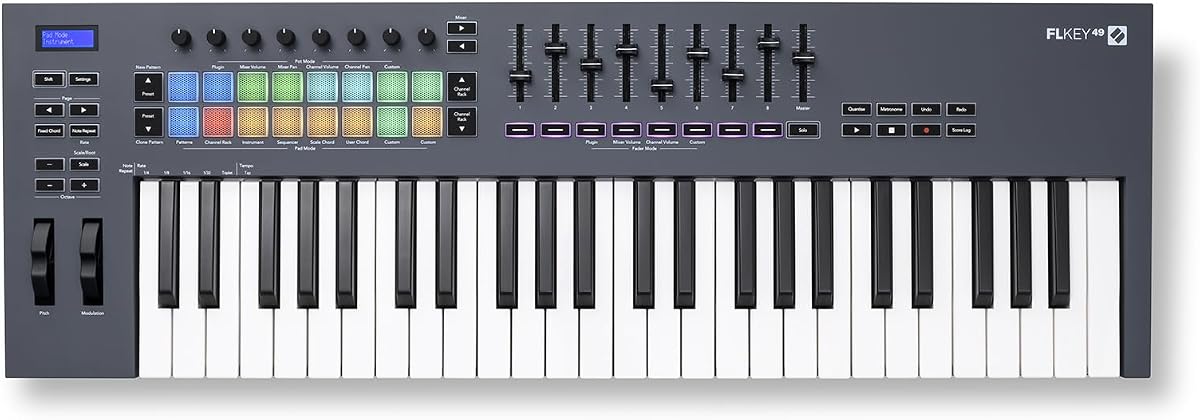
The Novation FLkey 49 is the ultimate controller for users of FL Studio. It brings the interface of the software off the screen and onto your hands for better control.
We may earn a commission when you buy through this link, at no additional cost to you.
Every button and fader is mapped specifically to FL Studio functions so you never need to use the mouse. This dedicated workflow saves time and helps you stay in the creative flow.
The pads in sequencer mode allow you to program beats with a natural human feel. You can change patterns instantly and trigger instruments with tactile feedback.
This controller is perfect if you already use FL Studio for your productions. The deep integration ensures you can focus on music rather than setup.
Having dedicated controls for FL Studio functions means you spend less time configuring and more time creating.
Sequencer mode on the pads mimics the step sequencer workflow allowing for fast beat programming.
We may earn a commission when you buy through this link, at no additional cost to you.
The M-AUDIO Oxygen Pro 49 is a feature-rich controller designed for advanced producers who need maximum control. It includes professional features like aftertouch and a physical MIDI output.
We may earn a commission when you buy through this link, at no additional cost to you.
The keybed offers a semi-weighted feel that provides resistance and expressiveness. This makes it suitable for playing realistic instrument parts and dynamic performances.
Its 16 assignable drum pads and extensive control options allow for deep integration with complex projects. The MIDI output ensures compatibility with hardware synthesizers and modules.
This controller is ideal for studio professionals who need to interface with both software and hardware. The comprehensive feature set supports a wide range of production needs.
The 5-pin MIDI output allows you to connect external hardware gear without needing an additional interface.
Aftertouch on the keys lets you add expression to your playing by pressing harder after a note is struck.
We may earn a commission when you buy through this link, at no additional cost to you.
The midiplus AK490 offers a straightforward and functional design for producers who need a reliable MIDI source. It covers the basics well without unnecessary bulk or complexity.
We may earn a commission when you buy through this link, at no additional cost to you.
It features standard MIDI out connectivity which ensures compatibility with almost any hardware or software setup. The velocity sensitivity allows for dynamic expression in your recordings.
Its simple layout makes it easy to use for quick sessions or mobile setups. You get the essential controls like pitch and modulation without extra clutter.
This controller is best for users who want a no-frills option. It provides core functionality at a budget-friendly price point.
Its lightweight build makes it easy to toss in a backpack for mobile recording sessions.
The standard MIDI out jack works with any hardware synthesizer that has a MIDI in port.
We may earn a commission when you buy through this link, at no additional cost to you.
The Generic 49-Key Controller is a minimal option for those who need a simple input device for music. It focuses on basic functionality to keep costs down and usability high.
We may earn a commission when you buy through this link, at no additional cost to you.
Its compact profile fits easily on any desk without taking up much space. This makes it suitable for small home studios or temporary setups where space is limited.
While it lacks advanced features it fulfills the core function of translating keyboard input to MIDI. The durable ABS construction ensures it survives regular handling in a studio environment.
This controller is best for beginners or secondary setups. It provides a reliable way to play notes without investment in complex features.
By stripping away extras it offers a no-nonsense tool for those who just need to play notes.
The small footprint ensures you can use it on cramped desks without crowding your other gear.
We may earn a commission when you buy through this link, at no additional cost to you.
Choosing the right controller involves understanding your specific workflow needs and budget constraints.
Velocity sensitivity ensures that the volume of a note changes based on how hard you press. This is essential for dynamic and expressive performances.
Look for velocity-sensitive keys to ensure your performance nuances are captured accurately.
Deep integration with your Digital Audio Workstation allows you to control mixing and transport without using the mouse. This significantly speeds up your workflow.
Choose a controller with preset mapping for your specific software to save setup time.
A sturdy build ensures the controller withstands transport and daily use. Materials like metal or high-density plastic improve durability.
Invest in a unit with robust construction if you plan to move it frequently.
Knobs and faders give you tactile control over effects and volume. This is vital for mixing tracks without touching a computer.
Select a model with enough assignable controls to match your mixing needs.
Many controllers come with bundled DAWs and virtual instruments. These can save you hundreds of dollars on initial software costs.
Check the software list to ensure it matches your production requirements.
Aftertouch allows you to modulate sound after a note is pressed. This adds expression and dynamics to your tracks.
If you want expressive performances prioritize models with aftertouch support.
49 keys offer a balance between space and range. However some models are lighter and more portable than others.
Consider your studio space and travel needs when choosing the physical size.
USB connectivity is standard but some units offer MIDI DIN outputs for hardware. USB-C is becoming common for power and data.
Ensure the port type matches your computer and hardware interface options.
Connect your keyboard to the computer using the included USB cable and install any necessary drivers. Most modern models are plug-and-play and require no installation.
Open your DAW and configure the MIDI settings to recognize the new controller. Assign knobs and faders to track parameters for a hands-on experience.
Keep your keyboard covered when not in use and dust the keys regularly with a soft cloth. Avoid placing heavy objects on the keys to prevent damage.
Most modern 49 Key MIDI Keyboards are plug-and-play via USB. However some older models may require drivers for full functionality.
Yes 49 keys are standard for production as they offer a good balance of range and desk space. They are sufficient for melodies chords and most arrangements.
Many models support iOS devices via adapters but check the specific USB power requirements. Some may need external power for phones or tablets.
Velocity changes volume based on hit speed while aftertouch changes parameters like filter cutoff after the key is pressed. Both add expression.
No MIDI keyboards send signals to your computer or sound module. You need a DAW or synthesizer to generate the actual audio.
Use a dry microfiber cloth or slightly damp cloth for dirt. Avoid chemicals or spraying liquid directly onto the keyboard to prevent damage.
Most manufacturers provide firmware updates on their websites. These can fix bugs and add new features to your controller over time.
Ableton Live Lite and FL Studio are popular starting points. The included software often covers basic production needs for learning.
The top picks offer diverse features ranging from the budget-friendly Nektar SE49 to the premium Arturia KeyLab mk3. Your choice should depend on your budget and specific production needs.
Focus on integration with your current software and the quality of the keybed. These factors will impact your daily workflow the most.
Prices for these controllers change frequently so always check current listings before making a purchase to ensure you get the best deal.