
2 Way Crossover for Speaker 300W Max
5.0Editor score
300W Max Power Handling
Ohmic and Banana Plug Interfaces
Integrated Junction Box Design
This guide compares the top 2 Way Speaker Crossovers for car and home audio, evaluating power handling, frequency division, and build quality to help you
Finding the right 2 Way Speaker Crossover is essential for achieving clear and balanced audio in any sound system. These devices split audio frequencies between woofers and tweeters, ensuring each speaker operates within its optimal range for maximum efficiency and sound quality.
We have analyzed ten top-rated models based on power handling, build materials, and user feedback. Our selection includes options for budget-conscious buyers and enthusiasts seeking high-fidelity performance. Each product offers unique features tailored to specific audio needs and installation scenarios.
Each pick highlights key specifications and real-world performance traits to guide your decision. Note that product availability and pricing may vary over time. Always verify current details before purchasing to ensure you get the best value for your audio upgrade project.
5.0Editor score

4.8Editor score

4.6Editor score
This table provides a side-by-side comparison of all ten selected 2 Way Speaker Crossovers. Review the key specifications and features to identify which model aligns best with your system requirements and audio goals.




The Dayton Audio XO2W-2.5K stands out as a premier choice for audiophiles seeking precision. With a 4.8 rating, it delivers reliable performance through its Linkwitz Riley alignment and 12 dB per octave slope. This model ensures smooth transitions between drivers for accurate sound reproduction.
We may earn a commission when you buy through this link, at no additional cost to you.
Its design uses 18 gauge inductors to keep DC resistance low, which improves amplifier efficiency. The low-pass section supports both 4 and 8 ohm woofers, offering flexibility for various setups. Components are securely mounted to prevent vibrations that could degrade audio quality over time.
While the fixed 2500 Hz point suits most standard setups, it lacks adjustability for custom tuning. Soldering skills are needed for installation, which might deter casual users. However, these trade-offs are acceptable given the consistent performance and durability offered at this price point.
Enthusiasts who prioritize sound accuracy should consider this crossover for their next build. It is ideal for home theater or stereo systems where driver matching is critical. We recommend it for anyone looking to upgrade from passive factory wiring to a dedicated frequency divider.
The Linkwitz Riley alignment ensures flat summed response and perfect phase coherence at the crossover point.
Using 18 gauge inductors reduces signal loss and heat buildup during high power playback sessions.
We may earn a commission when you buy through this link, at no additional cost to you.
The DS18 PRO-CFX offers concert-quality audio with a 300W RMS rating, perfect for high-performance systems. Rated at 4.6, it provides professional-grade precision to filter frequencies accurately. Its design allows one amplifier channel to power two speakers efficiently, maximizing your equipment investment.
We may earn a commission when you buy through this link, at no additional cost to you.
Crafted to create a tailored soundstage, this crossover ensures each driver contributes to impeccable sound quality. The compact size fits easily into most car audio installations without requiring major modifications. It handles raw power well, delivering a breath-taking experience that leaves listeners in awe.
The price is higher than standard options, which might be a barrier for budget builds. It is optimized for car audio, so home use may require additional adapters. However, for those seeking maximum loudness and accuracy in a vehicle, these factors are minor compared to the sound quality gains.
Buy this if you want to elevate your car audio to a professional level. It suits users who demand high power handling and precise frequency control. We suggest it for enthusiasts upgrading mid-range speakers to a full component system.
Filters frequencies for two components to ensure an immersive audio experience that is both rich and accurate.
Maximizes potential of two speakers while eliminating unwanted frequencies to ensure high quality contribution.
We may earn a commission when you buy through this link, at no additional cost to you.
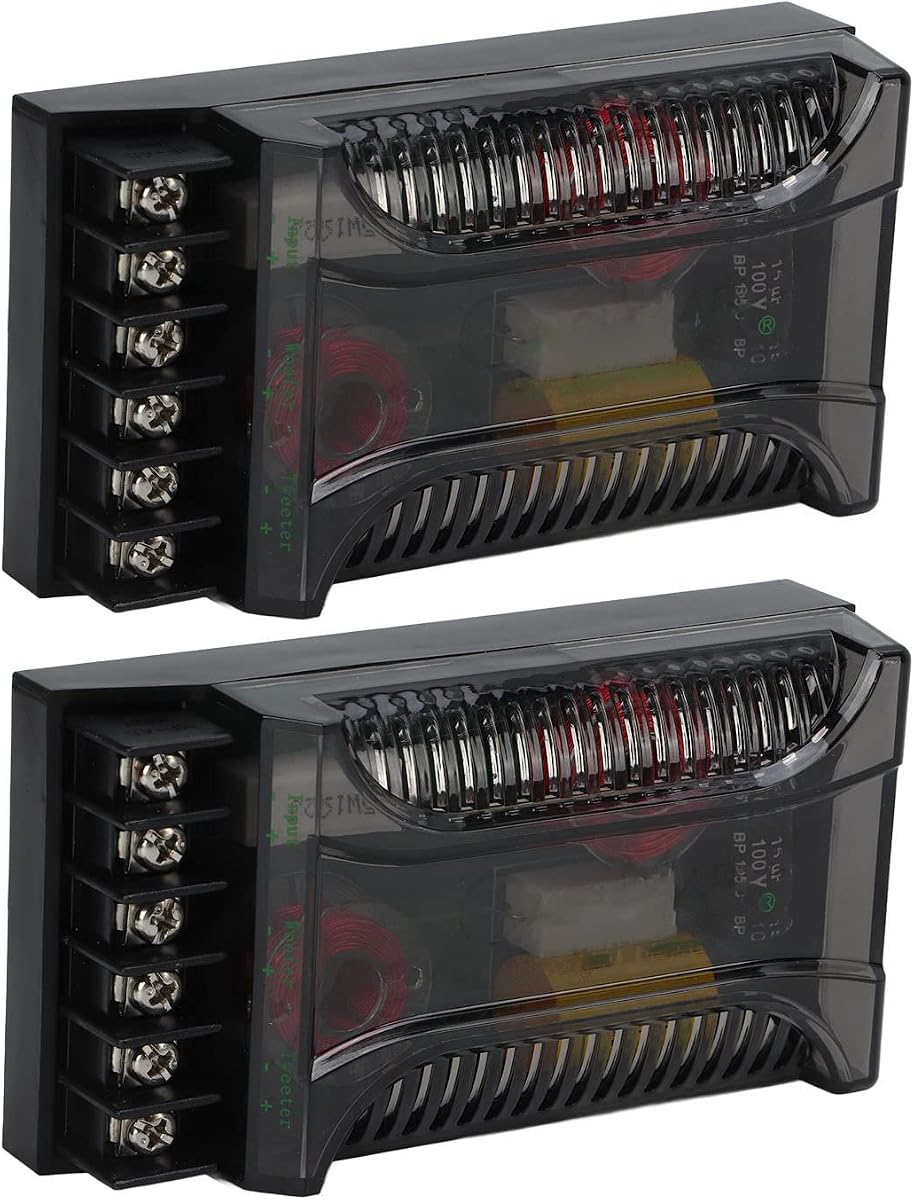
This crossover offers exceptional value with a perfect 5.0 rating and 300W max power handling. It features audio grade capacitors to minimize high frequency loss and deliver crystal clear sound. The integrated junction box simplifies mounting, saving significant time for DIY enthusiasts.
We may earn a commission when you buy through this link, at no additional cost to you.
Safety is a priority with built-in current cutoff during overloads to protect your gear. It supports both Ohmic terminals and banana plugs for versatile connectivity options. The pre-installed junction box eliminates messy wiring, making it a straightforward upgrade for existing speakers.
While the build materials are basic compared to premium brands, they are sufficient for most standard applications. Frequency adjustment options are limited, so you cannot fine-tune the split point. However, for the price, it provides reliable performance and convenience that are hard to beat.
We recommend this for budget builds or quick upgrades where ease of use matters most. It is suitable for small home systems or entry-level car audio projects. Choose this if you want a plug-and-play solution without sacrificing basic sound fidelity.
The integrated junction box allows direct mounting on the speaker exterior to save installation time.
Automatically cuts off excess current during overloads or short circuits to prevent damage to speakers.
We may earn a commission when you buy through this link, at no additional cost to you.
This 2-pack provides a cost-effective solution for upgrading multiple vehicle audio systems. With a 4.5 rating, it offers 150 Watts RMS and handles peaks up to 300 Watts. The gold plated screw terminals ensure reliable connectivity for long-term stability.
We may earn a commission when you buy through this link, at no additional cost to you.
High grade polymer capacitors help maintain signal integrity within the frequency range. It splits frequencies between 3.39 and 20kHz for tweeters and 20 to 4.3kHz for woofers. This setup supports general car audio needs without requiring complex wiring setups.
The RMS power is lower than some competitors, which limits high-volume usage. There is no mention of internal fuses for safety against overloads. Still, the 2-pack format offers excellent value for those outfitting multiple doors or locations simultaneously.
This is an ideal choice for replacing factory crossovers in daily drivers. It suits users who need a straightforward drop-in replacement. We suggest it for budget-conscious upgrades where basic frequency division is the primary goal.
Gold plated screw terminals provide secure connections that resist corrosion over time.
High grade polymer capacitors ensure stable frequency filtering for consistent audio output.
We may earn a commission when you buy through this link, at no additional cost to you.
This 450W crossover offers robust power handling with phase compensation features for clean sound separation. Rated at 4.5, it uses a second order 12dB low and third order 18dB high slope for better control. The frequency division point is adjustable between 2850 and 2900 Hz.
We may earn a commission when you buy through this link, at no additional cost to you.
A polypropylene capacitor improves sound quality by reducing interference. The dual protection system includes a fuse to prevent sudden silence during high-power work. This makes it suitable for high-fidelity setups that demand stability under stress.
The adjustable feature adds complexity that may require technical knowledge to tune correctly. The design is bulkier than minimalist options, which might limit fitting in tight enclosures. However, the sound quality improvements and protection features justify the extra effort.
We recommend this for DIYers who want to fine-tune their speaker response. It works well for car and home audio systems needing high power. Choose this if you prioritize sound precision and protection over simple installation.
Uses different slopes for low and high frequencies to ensure clean sound separation.
Combines capacitor and self-recovery fuse to protect tweeters from power surges.
We may earn a commission when you buy through this link, at no additional cost to you.
This adjustable model allows users to debug and tune sound effects according to personal interests. With 400W capacity, it supports treble and bass distribution effectively. The inductance uses anaerobic copper winding for stable performance during use.
We may earn a commission when you buy through this link, at no additional cost to you.
It is compatible with 2.1 systems and satellite boxes for flexible usage. The design allows convenient listening to sound effects to implement debugging control. This makes it a practical choice for experimental audio setups.
The rating is slightly lower than others, suggesting some variability in quality. It may not be as refined as higher-end options for critical listening. However, for hobbyists who enjoy tweaking settings, it offers great flexibility.
We suggest this for users who like to experiment with frequency settings. It fits well for small home systems or automotive loudspeakers. Choose this if you want full control over your audio filtering without high costs.
Implement overall debugging to implement control according to your own interests and preferences.
Inductance adopts anaerobic copper winding and pure copper wire for reliable connectivity.
We may earn a commission when you buy through this link, at no additional cost to you.
This model matches a wide variety of speakers with 4 to 12 Ohm compatibility. Rated at 4.2, it features scientific wiring arrangements with simulation and calibration. The 1.0mm wire diameter ensures high temperature resistance for durability in various conditions.
We may earn a commission when you buy through this link, at no additional cost to you.
The frequency point is adjustable at 2750 or 2800 Hz for customization. A solderless terminal block simplifies installation for assembly speakers. These features make it a strong candidate for upgrading existing audio setups.
The rating indicates average performance, which is acceptable for general use. The solderless terminals might require checking for tightness over time. Still, the broad impedance support and calibration offer decent value for the price.
We recommend this for users seeking a flexible replacement for standard dividers. It suits general home or car audio upgrades. Choose this if you need to match multiple speaker types with one model.
The wiring arrangement matches with the vast majority of speakers for easy upgrades.
The solderless terminal block is easy to install for quick replacement tasks.
We may earn a commission when you buy through this link, at no additional cost to you.
Designed with a high-gloss double-layer heat dissipation housing, this crossover manages heat effectively. Rated at 4.5, it features an overcurrent protector for safe usage during high power events. The bass inductor significantly improves bass sag for deeper sound.
We may earn a commission when you buy through this link, at no additional cost to you.
Solderless plug-in sockets guarantee easy connections for users. The workmanship is evident in the careful selection of materials for longevity. This design ensures durability without compromising on performance in typical car environments.
It is tailored specifically for car audio, which limits home system versatility. The frequency split is not adjustable, so tuning is fixed. Still, the heat management and safety features provide reliable operation in hot engine bays.
We suggest this for car audio systems needing thermal protection. It suits users looking for straightforward upgrades with safe operation. Choose this if you want durable performance in vehicle enclosures.
High-gloss double-layer heat dissipation ABS plastic housing ensures durability and longevity.
Boasts a bass inductor and magnet to significantly improve the bass sag.
We may earn a commission when you buy through this link, at no additional cost to you.
This crossover offers a balance of affordability and functionality for HiFi needs. Rated at 4.3, it supports a wide range of speaker impedances from 4 to 12 Ohms. The frequency point is adjustable between 2750 and 2800 Hz for tuning.
We may earn a commission when you buy through this link, at no additional cost to you.
It uses polypropylene audio frequency coupling high voltage capacitors for capacitance. The inductor wire diameter is 1.0mm for resistance to high temperatures. These components provide decent performance for general home or car audio use.
Build quality is average, so careful handling during installation is recommended. It lacks premium features found in higher-priced models. However, for the price, it delivers the core functions needed for basic frequency division.
We recommend this for users needing a simple replacement or upgrade. It suits setups where budget is a primary concern. Choose this if you want adjustable features without a significant investment.
Uses polypropylene capacitors for high tone capacitance and better audio coupling.
Offers an adjustable frequency point to tailor the split to your speakers.
We may earn a commission when you buy through this link, at no additional cost to you.
Dayton Audio delivers another solid model with a fixed 3000 Hz crossover point. With a 4.8 rating, it ensures components are glued to eliminate buzzing and vibrations. The 18 gauge inductors keep DC resistance minimal for efficient signal flow.
We may earn a commission when you buy through this link, at no additional cost to you.
The high quality blue PC board uses a back plate for added rigidity. This design reduces unwanted resonance that could color the audio signal. It supports 4 or 8 ohm woofers, offering flexibility for most standard setups.
The fixed frequency limits customization for unique driver pairings. It is optimized for 3kHz applications, so other splits might need different models. However, the build quality and brand reputation ensure long-term reliability.
We recommend this for users who need a dependable 3kHz split. It is ideal for standard component systems where reliability is key. Choose this if you want a straightforward, high-quality divider for known driver specs.
All components are glued or fastened down to eliminate buzzing and vibrations.
High quality blue PC board uses a back plate for added rigidity and stability.
We may earn a commission when you buy through this link, at no additional cost to you.
Selecting the right crossover requires understanding several key technical and practical factors. This guide breaks down what to prioritize based on your system and goals.
Check the RMS and peak power ratings to ensure the crossover can handle your amplifier output without failure. A 300W model might suit high-performance systems while a 150W option fits modest daily drivers.
Always match the crossover power rating to your speakers to avoid damage.
The crossover point determines where sound splits between woofers and tweeters. Fixed points like 2500Hz or 3000Hz are standard, but adjustable units offer flexibility for custom tuning.
Choose a fixed point that matches your driver specs or adjustable if you want to experiment.
Most crossovers support 4 or 8 ohm systems. Some advanced models support up to 12 ohm for versatile integration. Ensure the unit matches your speaker's impedance.
Verify Ohm ratings to prevent underloading or overloading your speakers.
Look for high-grade capacitors and inductors with copper windings. Heat dissipation features like double-layer housings help during long sessions. Durable terminals prevent connection failures.
Quality components ensure long-term reliability and consistent sound.
Solderless terminals make DIY projects easier for beginners. Models with junction boxes simplify mounting directly to speakers. Standard PCBs might require extra wiring steps.
Pick the style that matches your technical comfort level and available space.
Some models include fuses or overcurrent protection to prevent damage from power surges. This safety layer protects expensive tweeters during high-volume events.
Prioritize units with built-in safety if you push your system hard.
Prices range widely based on materials and features. Premium models cost more but offer better sound separation. Budget models deliver basic functions at a lower cost.
Assess how much you value accuracy versus savings before choosing.
Car audio units often handle heat and vibration better. Home HiFi models focus on sound neutrality. Universal options work in both but might excel in neither.
Select a crossover designed for your primary environment.
First disconnect all power before connecting wires. Match input from your amp to the crossover input and outputs to your speakers. Use correct impedance wiring to avoid shorts or signal loss.
Secure the unit firmly to prevent vibration. If using solderless terminals, check tightness periodically. For adjustable models, set the frequency point based on driver specs before testing.
Keep the crossover clean and free of debris. Avoid extreme heat by ensuring airflow around the unit. Check connections annually to maintain optimal performance over time.
It splits audio signals into separate frequency bands. One signal goes to woofers for lows and another to tweeters for highs. This prevents distortion and maximizes efficiency.
Yes, passive speakers require a crossover to separate frequencies. Without one, all frequencies would hit all drivers causing distortion and potential damage. It is essential for component setups.
Check your tweeter and woofer specs for recommended range. A common split is 2500Hz to 3000Hz. If your drivers have specific limits, match the crossover to those ranges.
Passive crossovers are easier to install and don't need extra gear. Active ones offer more control but require amplification for each band. Passive is standard for simple upgrades.
It is not recommended as it can cause impedance mismatches. Always match the Ohm rating to ensure safe power delivery. Using the correct value protects your gear.
Check annually or if you notice sound issues. Loose connections can lead to static or failure. Vibration in cars may loosen wires over time.
We compared ten top models ranging from budget-friendly options to high-end precision units. The Dayton Audio XO2W-2.5K leads for accuracy, while the 300W model offers great value. Each provides a different balance of features.
Prioritize power handling and frequency points that match your speakers. Safety features and build quality ensure longevity under demanding conditions. Choose based on your specific installation needs.
Always check current prices and availability before buying since these change often. Verify all specs match your system before finalizing your choice. We hope this guide helps you find the perfect upgrade.