
Askar 71F Flat-Field Telescope, 71mm Aperture F6.9 ED Glass Refractor OTA
4.9Editor score
Self-flattened optical design
Lightweight portable build
Versatile visual use
This guide compares the top apochromatic refractors for astrophotography and visual astronomy, analyzing optics, portability, and value for serious observers.
Apochromatic refractors are the gold standard for clear, color-free views of the night sky. These telescopes use specialized glass to eliminate chromatic aberration, delivering crisp images perfect for both visual observing and capturing stunning deep-sky photographs with high fidelity.
We evaluated ten leading models based on optical performance, build quality, portability, and value. Our comparison covers triplet and quadruplet designs across various apertures, ensuring you find the right scope whether you are chasing nebulae, galaxies, or planetary details with precision.
Each pick highlights key features, pros, and cons to help you decide confidently. Note that product availability and pricing can fluctuate frequently, so always verify current listings before purchasing to ensure you get the best deal for your specific needs and budget.
4.9Editor score

4.5Editor score

5.0Editor score
The following table provides a quick side-by-side overview of the top ten apochromatic refractors, highlighting their key specifications and primary strengths to help you compare options efficiently.




The SVBONY SV550 AP0 stands out as a top-tier choice for serious observers seeking an affordable yet high-performance apochromatic refractor. With its 80mm triplet ED glass design, it delivers stunning clarity and color fidelity that rivals much more expensive scopes.
We may earn a commission when you buy through this link, at no additional cost to you.
Its air-spaced triplet optical design virtually eliminates chromatic aberration, ensuring bright, high-contrast images of galaxies and nebulae. The magnesium alloy dual-speed focuser provides precise control, while the extreme extinction measures within the barrel reduce stray light for darker backgrounds.
While it lacks a built-in dew shield and requires a separate mount for optimal use, these are minor trade-offs given the optical performance. The lightweight design makes it ideal for transport to dark sky sites without sacrificing image quality.
This scope is perfect for astrophotographers and visual enthusiasts who want premium optics without breaking the bank. We highly recommend it as a primary imaging instrument or a portable travel telescope for capturing the wonders of the night sky.
The triplet structure with S-FPL51 ED glass effectively corrects blue-edge aberrations, producing true-to-life colors in both visual and photographic applications.
A 1:10 dual-speed focuser allows for fine adjustments critical for sharp focus, especially when using full-frame cameras for astrophotography.
We may earn a commission when you buy through this link, at no additional cost to you.
The Explore Scientific ED80 brings renowned optical quality to the mid-range market. Its use of genuine FCD1 HOYA extra-low dispersion glass ensures exceptional image clarity and color accuracy, making it a favorite among demanding astrophotographers.
We may earn a commission when you buy through this link, at no additional cost to you.
Designed with portability in mind, this scope features a retractable dew shield and a compact form factor. The push-pull collimation system allows for precise adjustments to maintain tight star points, while USA-based support offers peace of mind for users.
The main trade-off is its slightly higher price and weight compared to similar offerings. However, the optical performance and build quality justify the cost for those prioritizing image fidelity and durability in their observing gear.
Ideal for users seeking a balance between performance and usability, the ED80 excels in capturing detailed images of the Moon, planets, and deep-sky objects. It remains a strong contender for anyone looking to upgrade their visual or imaging capabilities.
Proprietary enhanced multi-layer coatings on FCD1 glass produce brilliant, high-contrast views filled with stunning details across the field of view.
The front cell features push-pull adjustments to ensure optimal collimation for the tightest stars possible, essential for high-resolution imaging.
We may earn a commission when you buy through this link, at no additional cost to you.
This SVBONY SV550 bundle offers a comprehensive solution for deep-sky astrophotography. By including the SV209 field flattener, it ensures flat fields essential for capturing crisp stars across the entire frame of full-frame cameras.
We may earn a commission when you buy through this link, at no additional cost to you.
The scope itself features a lightweight magnesium alloy focuser and extreme extinction measures to minimize stray light. The 180mm dovetail plate adds stability, while the optimized back focal length simplifies setup for photographers.
The main consideration is the higher price due to the included accessories. However, purchasing the bundle saves money and effort compared to buying components separately, making it a smart investment for dedicated imagers.
Perfect for photographers who want everything needed to start capturing stunning nebulae and galaxies, this package delivers professional results out of the box. We recommend it for those ready to commit to serious astrophotography without the hassle of sourcing parts.
The SV209 flattener corrects field curvature and supports a wide effective field of view for both half-frame and full-frame cameras.
Equipped with extension tubes and adapters to ensure the conventional 55mm back focal length for precise imaging alignment.
We may earn a commission when you buy through this link, at no additional cost to you.
The SVBONY SV550 122mm offers a significant aperture boost for travelers who need light-gathering power. Its compact design and integrated carrying handle make transporting a large-aperture scope surprisingly easy for remote observing sessions.
We may earn a commission when you buy through this link, at no additional cost to you.
The FPL-51 triplet structure ensures excellent correction of aberrations, providing clear and sharp images of deep-sky objects. The included dovetail base and finder scope mount bracket simplify setup, allowing you to focus on imaging quickly.
While specific user ratings are not yet available, the design features suggest strong potential for both visual and imaging use. The trade-off is the higher price point, which reflects the premium materials and added convenience features.
Ideal for observers who want more light without sacrificing portability, this model balances performance and convenience effectively. We suggest considering it for those aiming to capture fainter deep-sky objects with a manageable weight profile.
A 122mm aperture gathers significantly more light, allowing for better visibility of fainter deep-sky objects and improved limiting magnitude.
The convenient carrying handle and lightweight design allow for easy transport and setup during spontaneous stargazing sessions.
We may earn a commission when you buy through this link, at no additional cost to you.
The Askar 71F redefines value with its self-flattened optical design and ultra-lightweight build. This scope is perfect for both visual observation and photography, offering a versatile platform that fits easily into travel setups.
We may earn a commission when you buy through this link, at no additional cost to you.
Its quadruplet air-spaced APO design ensures excellent color correction, while the CNC-processed barrel reduces stray light effectively. The ability to rotate the tube 360 degrees simplifies framing and composition without moving the entire mount.
The primary limitation is its smaller 71mm aperture compared to larger rivals. However, for the price, the performance and portability are unmatched, making it a favorite for beginners and travel imagers seeking convenience.
We recommend this scope for anyone prioritizing weight and versatility. Whether you are watching birds, scouting landscapes, or imaging deep-sky targets, the 71F delivers high-quality results without the burden of heavy equipment.
As an affordable self-flattened OTA, it eliminates the need for additional field flatteners, simplifying your imaging train significantly.
High-quality CNC processing and matte paint inside the barrel minimize internal reflections for darker sky backgrounds.
We may earn a commission when you buy through this link, at no additional cost to you.
The SVBONY SV503 brings a substantial 102mm aperture to the table, offering brighter and higher-contrast images suitable for both visual observing and astrophotography. Its FMC coating significantly improves light transmission and reduces internal reflections.
We may earn a commission when you buy through this link, at no additional cost to you.
A 360-degree field rotator allows for perfect camera alignment without tube rotation, while the smooth dual-speed focuser ensures precise focus. The aluminum retractable hood actively blocks stray light and prevents dew formation for stable viewing.
While the larger aperture increases weight, the optical benefits for planetary and deep-sky observation are clear. The 90mm focus travel accommodates various accessories like filter wheels, enhancing flexibility for different observing scenarios.
Ideal for adults seeking a robust telescope that can handle serious observation, this model delivers excellent value. We recommend it for users who want a balance of light-gathering power and optical clarity without stepping into premium pricing.
The 102mm diameter gathers more light than smaller refractors, delivering brighter images with true-to-life color and sharp detail.
A built-in dual-speed focuser coupled with a field rotator makes achieving critical focus effortless for photographers and visualists alike.
We may earn a commission when you buy through this link, at no additional cost to you.
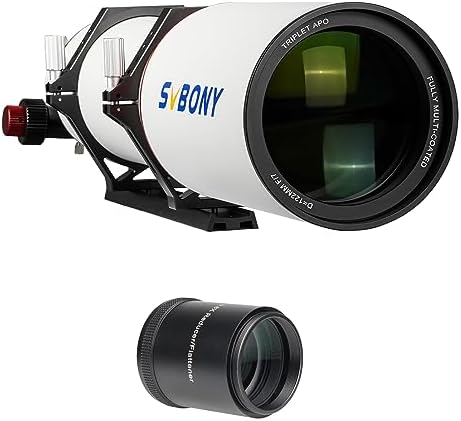
This SVBONY SV550 bundle combines a powerful 122mm aperture with a focal reducer and field flattener for wide-field imaging excellence. It corrects field curvature effectively, ensuring stars remain sharp even at the edges of your sensor.
We may earn a commission when you buy through this link, at no additional cost to you.
The 0.8X reducer transforms the scope's f/7 ratio into a faster system, reducing exposure times and enabling capture of large nebulae and galaxy clusters. The included flattener improves efficiency at the field edge for consistent quality.
Users should note that this bundle is optimized for serious astrophotography and requires a sturdy mount to handle the optics. The price reflects the high-end nature of the components and the convenience of a pre-matched system.
Perfect for enthusiasts ready to tackle deep-sky targets with wide-field frames, this setup delivers outstanding clarity and speed. We recommend it for those seeking maximum versatility and performance in their imaging toolkit without compromise.
The focal reducer effectively shortens focal length, allowing for faster imaging sessions and broader coverage of the night sky.
The field flattener corrects defects in field curvature, ensuring crisp star points across the entire image frame.
We may earn a commission when you buy through this link, at no additional cost to you.
This comprehensive kit offers a robust platform for deep-sky astrophotography. The 122mm aperture collects significant light, while the included SV209 flattener ensures flat fields essential for high-resolution imaging across the frame.
We may earn a commission when you buy through this link, at no additional cost to you.
Designed for both travel and performance, the scope features a portable handle for easy carrying and a compact form factor. The optical design reduces chromatic aberration, enhancing clarity and sharpness for detailed target capture.
Although specific user ratings are limited, the features align with high-quality imaging expectations. The main consideration is the total cost, which reflects the bundled nature of the accessories and the larger aperture size.
Ideal for photographers looking for an all-in-one solution to explore faint deep-sky objects, this kit offers significant value. We suggest it for those ready to upgrade their imaging capabilities with proven optical performance and convenience.
The 122mm aperture gathers more light to offer clear, detailed images suitable for even fainter deep-sky objects.
A comfortable carrying handle makes transport easier, allowing you to move a large-aperture telescope with minimal effort.
We may earn a commission when you buy through this link, at no additional cost to you.
This SVBONY SV550 kit blends visual performance with imaging readiness. The 80mm triplet design with S-FPL51 ED glass minimizes color fringing, while the ultra-wide band coating ensures bright and clear views of celestial bodies.
We may earn a commission when you buy through this link, at no additional cost to you.
The included SV209 field flattener improves image quality at the edges of the field, making it suitable for capturing targets like M42 and M45 with sharpness. The comfortable carrying handle improves safety during setup.
Visually, the image is inverted, which is standard for astronomical refractors and acceptable for night sky use. The main trade-off is reliance on the provided accessories for optimal performance.
Perfect for observers who want a versatile scope capable of both looking and capturing, this kit offers high-quality optics in a portable package. We recommend it for those seeking a reliable, easy-to-use telescope for general astronomy.
Ultra-wide band fully multilayer coated lenses prevent irritating reflections, delivering bright and clear images of celestial targets.
Ideal for observing common Messier catalog targets like M42 and M45 with simple difficulty factors and great clarity.
We may earn a commission when you buy through this link, at no additional cost to you.
This comprehensive bundle provides everything needed for precision astrophotography. The 122mm aperture captures detailed deep-sky images, while the included guide scope and camera ensure accurate tracking for long exposures.
We may earn a commission when you buy through this link, at no additional cost to you.
The SV905C camera features a high peak QE and low read noise, allowing tight tracking of faint guide stars. Its compact design and mainstream auto-guiding compatibility simplify integration into existing imaging rigs.
For users seeking a complete tracking solution, this kit saves the hassle of sourcing separate components. The price reflects the bundle nature, which justifies the cost for those needing reliable autoguiding capabilities.
Ideal for serious photographers aiming for deep-sky targets, this bundle offers professional-grade tools in one package. We recommend it for those ready to take their imaging to the next level with integrated guiding support.
Small pixels and high peak QE allow for tight tracking of faint guide stars, improving overall imaging stability.
A highly sensitive 1.23-megapixel camera with a 1/3” CMOS sensor delivers excellent performance for autoguiding tasks.
We may earn a commission when you buy through this link, at no additional cost to you.
Selecting the right apochromatic refractor requires understanding several key factors that impact performance, portability, and value. This guide helps you prioritize what matters most for your observing and imaging needs.
Aperture determines how much light the telescope can gather, affecting image brightness and detail resolution. Larger apertures like 122mm reveal fainter deep-sky objects but add weight and require more robust mounts.
For travel and visual use, 71mm to 80mm offers a good balance between performance and convenience without excessive bulk.
APO refractors use triplet or quadruplet designs with extra-low dispersion glass to minimize chromatic aberration. Air-spaced triplets offer excellent color correction and thermal stability compared to cemented lenses.
Look for FPL-51 or FCD1 glass for superior performance that delivers true-to-life colors in your images.
Focal ratio (f-number) impacts exposure times and field of view. Faster scopes around f/6 to f/7 allow shorter exposures and cover larger targets, while slower scopes provide higher magnification for detailed work.
Choose f/6 to f/7 for versatile imaging that balances speed and sharpness effectively across various targets.
Transporting your scope to dark sites requires a lightweight and compact design. Magnesium alloys and retractable dew shields significantly reduce weight without sacrificing build quality or thermal stability.
Prioritize models with carrying handles or small footprints if you plan to travel frequently with your gear.
A high-quality focuser with dual-speed gearing ensures precise focus essential for sharp images. Focusing travel must accommodate accessories like filter wheels and camera adapters without compromising alignment.
Look for 1:10 reduction ratios and rotation options to simplify camera setup and maintain focus accuracy.
Bundles often include field flatteners, reducers, or camera accessories that save money and simplify setup. Ensure included parts match your sensor size and camera interface to avoid compatibility issues.
Check if bundles come with dovetail plates and handles, which improve usability and transport convenience significantly.
Reliable customer service and warranty coverage provide peace of mind for long-term ownership. Opt for brands with responsive support teams that can assist with collimation or optical issues promptly.
Local or regional support options can be valuable if you encounter shipping or technical challenges during use.
Prices vary widely based on optics quality and included accessories. Balance your desired aperture and features against your budget to find the best value without compromising essential performance characteristics.
Investing in quality glass and coatings often yields better long-term satisfaction than cheaper alternatives with inferior optics.
Start by allowing your scope to acclimate to outdoor temperatures before use to prevent internal air currents. This ensures sharp focus and minimizes dew formation on the optical surfaces during observation sessions.
Use a dew shield or heater when observing in humid conditions to keep the objective lens clear. Regularly inspect the optics for dust and clean only with proper brushes or lens cloths to avoid scratches.
Always secure your telescope firmly on a stable mount to prevent vibrations that blur images. Store the scope in a dry, climate-controlled environment to protect the optical coatings and mechanical parts over time.
Apochromatic refractors use extra-low dispersion glass and multi-element designs to virtually eliminate chromatic aberration. This results in sharper, color-free images compared to standard achromatic refractors that often show purple fringing around bright objects.
Absolutely. APO refractors deliver stunning high-contrast views ideal for visual astronomy. Their color correction and optical quality make them excellent for observing planets, star clusters, and galaxies with exceptional clarity.
For most cameras and larger sensors, a field flattener is recommended to correct field curvature. It ensures stars stay sharp across the entire image frame, improving edge quality significantly for professional-looking astrophotos.
Beginners often benefit from 70mm to 80mm apertures that balance performance with portability and cost. These sizes offer great light-gathering power while remaining manageable for transport and setup without requiring heavy-duty mounts.
Yes, they work well for terrestrial viewing with proper accessories. However, always use a solar filter for solar observation and avoid pointing unmodified scopes at the sun directly to prevent eye damage.
APO refractors typically require minimal collimation since lenses are fixed. If adjustment is needed, it usually involves simple push-pull screws on the front cell and takes only a few minutes with proper tools.
Bundles often provide better value by including essential accessories like field flatteners or dovetail plates. Purchasing separately may cost more overall, so bundles are worth considering if you need those specific items.
APO refractors are lightweight and work well with most equatorial or alt-az mounts. Choose a mount rated to support at least 1.5 to 2 times the scope's weight to ensure stability and precise tracking.
We have explored ten outstanding apochromatic refractors that cover diverse needs from compact visual observing to professional deep-sky imaging. Each model offers unique strengths in optical quality, portability, and accessory bundles.
Prioritize aperture size, focal ratio, and bundle contents based on your primary observing goals. Whether you value light weight for travel or large apertures for faint targets, there is a perfect match in this lineup.
Remember to verify current pricing and availability before making your purchase as these factors change frequently. Selecting the right APO refractor will enhance your astronomy experience for years to come.