This guide compares the top Arduino ADC Board options for 2026, evaluating resolution, channel count, interface type, and compatibility to help you choose the
As an Amazon Associate we earn from qualifying purchases. We may earn a commission when you buy through links on this page, at no additional cost to you. Read our affiliate disclosure.As an Amazon Associate we earn from qualifying purchases.Purchases through our links may earn us a commission, at no extra cost to you. Read our affiliate disclosure.
Selecting the right analog-to-digital converter is crucial for embedded projects. A quality Arduino ADC Board transforms sensor signals into digital data, enabling precise measurements for robotics, environmental monitoring, and industrial control systems effectively.
We evaluated ten leading modules based on resolution, channel flexibility, communication protocols, and ease of integration. Our comparison highlights boards suited for beginners alongside high-performance units designed for demanding data acquisition tasks requiring accuracy and reliability.
Each product entry details key specifications, strengths, and potential limitations to guide your purchase. Prices and availability fluctuate frequently, so verify current offers before ordering. Read on to find the ideal ADC solution matching your specific development needs today.
Top 3 Picks for Best Arduino ADC Board
Best Budget
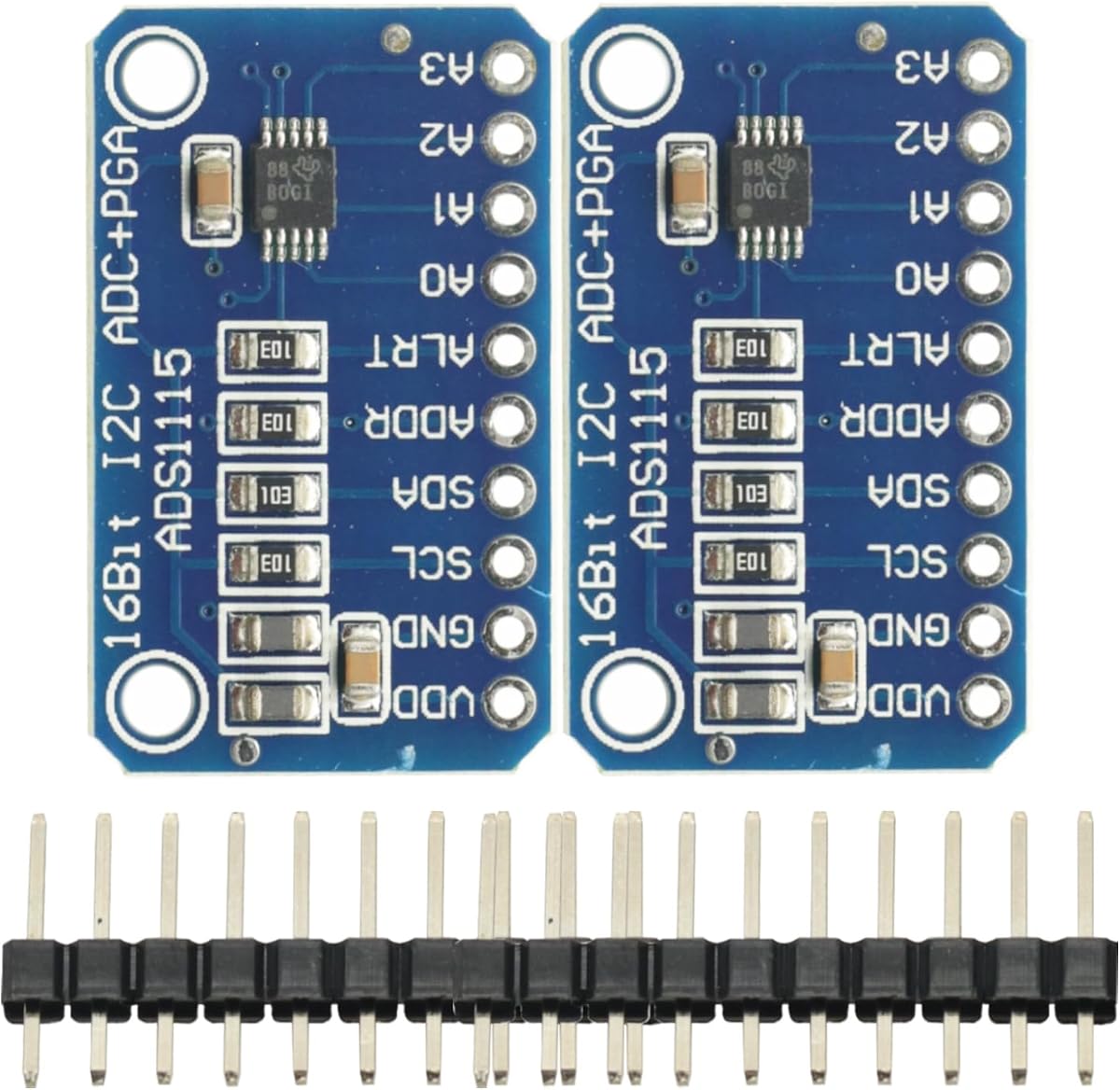
2Pcs ADS1115 16 Bit I2C Module Precision ADC 4 Channel Analog-to-Digital Converter Development Board Pro Gain Amplifier for Arduino Raspberry Pi ADC Module
The following table provides a side-by-side overview of all ten selected Arduino ADC Board options. It highlights core specifications like resolution, input channels, and interface types to help you quickly identify the most suitable module for your hardware setup.
Teyleten Robot ADS1115 16 Bits 4 Channel Analog-to-Digital Converter Precised Develop Board Module Amplifier Board ADC I2C IIC for Arduino Raspberry Pi (Pack of 3pcs)
16-bit resolution
4 channels
I2C interface
2.0V-5.5V
This ADS1115 module stands out as a top choice for hobbyists and engineers needing reliable analog data conversion. With a 4.7 rating from users, it delivers consistent performance across a variety of sensors. The board supports both single-ended and differential inputs, making it versatile for different measurement scenarios. Its small form factor ensures it fits neatly into breadboards or custom PCBs without taking up excessive space.
Pros
High precision readings
Flexible voltage supply
Programmable data rate
Single-shot mode
Wide compatibility
Cons
Requires external pull-up resistors
Limited to lower sample rates
We may earn a commission when you buy through this link, at no additional cost to you.
Key strengths include its programmable gain amplifier which allows measurement of small voltage changes with high accuracy. You can adjust input ranges from ±0.256V to ±6.144V to suit your specific sensor output levels. The onboard oscillator eliminates the need for external timing components simplifying circuit design. Additionally, the data rate can be configured between 8sps and 860sps balancing speed and noise filtering needs effectively.
While the board is excellent, there are trade-offs to consider. The maximum sample rate of 860sps might be too slow for fast signal analysis applications like audio processing. Users also need to ensure proper pull-up resistors are installed on the I2C lines for stable communication. However, these limitations are standard for this class of chip and rarely impact general DIY or industrial monitoring projects.
Ideal for users building weather stations, pH meters, or battery monitors, this module offers the best balance of price and performance. The three-pack option provides value for projects requiring multiple ADCs or spare units. If you need precise voltage measurement without complex wiring, this ADS1115 variant is the recommended choice for your Arduino setup.
For projects requiring multiple sensors, the I2C address pins allow chaining up to four units on one bus. This scalability makes it possible to monitor sixteen different analog channels using a single microcontroller. Ensure your wiring follows the datasheet pinout to avoid signal integrity issues during operation.
Precision Gain Amplifier
The internal PGA lets you amplify weak signals before conversion improving overall measurement resolution significantly.
Flexible Power Options
Operating from 2.0V to 5.5V ensures compatibility with both 3.3V and 5V logic systems without level shifters.
HiLetgo ADS1256 5V 8 Channel 24 Bit ADC Data Acquisition Board Module High Precision AD Collecting Data Acquisition Card
24-bit resolution
8 channels
30ksps sample rate
Low nonlinearity
The ADS1256 module delivers professional-grade data acquisition capabilities in a compact board format. With a 4.6 rating, it appeals to users needing extreme precision for lab or industrial environments. The 24-bit resolution allows detection of minute voltage changes that 12-bit or 16-bit ADCs would miss. It includes a precision reference voltage source ensuring stable measurements over time.
Pros
Ultra-high 24-bit precision
Eight analog inputs
Onboard reference voltage
Excellent for strain gauges
Programmable filter
Cons
Higher power consumption
More complex SPI wiring
We may earn a commission when you buy through this link, at no additional cost to you.
Its ability to handle up to 30ksps makes it significantly faster than standard 16-bit options while maintaining high accuracy. You can configure it for eight single-ended or four differential inputs providing flexibility for complex sensor arrays. The low nonlinearity ensures that readings remain accurate across the entire input range which is critical for calibration tasks.
Drawbacks include the need for a stable power supply since it draws more current than simpler modules. The SPI interface requires more microcontroller pins than I2C which might be a constraint on smaller boards like the Arduino Nano. Despite this, the performance gains justify the extra effort for applications demanding high fidelity and fast data collection.
Best suited for load cells, pressure transducers, or high-precision instrumentation, this board excels where quality matters most. If your project involves monitoring slow-changing but highly critical signals, this ADS1256 module provides the necessary resolution and stability. It pairs well with microcontrollers that have multiple SPI peripherals or available GPIOs.
Users should pay attention to the input voltage range which is typically limited to 3V for this module. External voltage dividers might be necessary for measuring higher voltage signals safely. Proper shielding of input wires is also recommended to prevent noise from affecting the high-resolution readings.
Internal Reference Voltage
Built-in precision reference eliminates drift issues often seen with external reference voltage sources.
Differential Input Support
Differential inputs reject common-mode noise improving signal integrity in electrically noisy environments.
2Pcs ADS1115 16 Bit I2C Module Precision ADC 4 Channel Analog-to-Digital Converter Development Board Pro Gain Amplifier for Arduino Raspberry Pi ADC Module
16-bit resolution
4 channels
I2C interface
7 input ranges
This two-pack offers exceptional value for students or makers on a budget. With a perfect 5.0 rating from reviewers, it performs reliably for most standard analog conversion tasks. Buying two units allows you to prototype multiple setups or keep a spare for experimentation without extra cost. The boards come with clear labeling which simplifies wiring for beginners.
Pros
Highly affordable pricing
Two-pack included
Programmable gain amplifier
User-friendly I2C
Wide input voltage
Cons
Basic PCB material quality
No pre-soldered headers
We may earn a commission when you buy through this link, at no additional cost to you.
Features include the same high-quality ADS1115 chip found in more expensive boards ensuring accurate conversion. The programmable gain amplifier allows you to adjust sensitivity for low-voltage signals effectively. You can select from seven input ranges to optimize resolution for your specific sensor. The I2C interface keeps wiring minimal with just four connections needed.
The main trade-off is the PCB finish and lack of pre-soldered headers on some batches. You may need to solder pin headers yourself which adds a small step to setup. However, this does not impact electrical performance and is a common feature in budget electronics. For those comfortable with basic soldering, this remains a top choice.
Ideal for classroom projects or hobbyist kits, this pack ensures you have enough ADCs for multi-station labs or testing. If you need to interface multiple sensors across different locations, having two boards ready to go saves time. It is a cost-effective solution that does not compromise on core conversion accuracy.
Verify the address configuration if using both boards on the same I2C bus. Changing the ADDR pin on one unit allows both to coexist without conflict. This flexibility makes it easy to expand your analog monitoring capabilities as your project grows.
Easy I2C Integration
Standard I2C protocols ensure easy software compatibility with most Arduino and Pi libraries.
Seven Input Ranges
Selectable input ranges help you maximize resolution for different sensor voltage levels.
HiLetgo 3pcs ADS1115 16 Bit 16 Byte 4 Channel I2C IIC Analog-to-Digital ADC PGA Converter with Programmable Gain Amplifier High Precision ADC Converter Development Board for Arduino Raspberry Pi
16-bit resolution
4 channels
I2C interface
Auto shutdown
This three-pack provides substantial value for projects requiring multiple analog inputs. With a 4.3 rating, it offers reliable performance for general data acquisition tasks. The inclusion of three boards means you can expand your sensor array significantly or keep extras for future use. Each unit functions independently or can be chained on the same I2C bus.
Pros
Three units included
Comparator mode support
Wide voltage supply
High precision
Compact design
Cons
Inconsistent quality control
Soldering required
We may earn a commission when you buy through this link, at no additional cost to you.
Key features include comparator mode which allows hardware-based threshold detection without constant polling. This helps reduce CPU load when monitoring for specific voltage levels like battery low warnings. The wide voltage supply ensures stable operation across various power sources. Auto shutdown in single-shot mode helps reduce power draw in battery applications.
Quality control varies between batches with some units requiring careful handling during soldering. This inconsistency can lead to occasional defects but does not reflect the underlying chip quality. Users should test each board upon arrival to ensure functionality. Despite this, the price per unit remains very competitive for the features provided.
Best for educators or groups needing multiple identical units for simultaneous work, this set simplifies bulk purchasing. If you are building a multi-zone environmental monitor, having three modules simplifies the wiring and code structure. It offers a practical way to scale up analog channels without complex multiplexing hardware.
Ensure you use the correct library version for Arduino to handle the different I2C addresses correctly. The ADDR pins can be set to access all three units on one bus. Proper addressing prevents communication conflicts and ensures each board is read as intended.
Comparator Mode
Hardware comparator mode detects voltage thresholds without polling freeing up processor resources.
Auto Shutdown Feature
Auto shutdown reduces power consumption during idle periods extending battery life in portable devices.
This four-pack is perfect for large scale monitoring systems needing extensive analog channels. With a 4.1 rating, it provides solid functionality for industrial or educational setups. Having four units allows you to connect up to sixteen sensors using a single I2C bus. This simplifies wiring compared to multiple analog inputs on a microcontroller.
Pros
Four units included
High scalability
Internal oscillator
Differential support
Wide supply voltage
Cons
Potential I2C bus noise
No pre-soldered pins
We may earn a commission when you buy through this link, at no additional cost to you.
The internal oscillator removes the need for external timing components reducing part count. Differential input support helps reject noise in environments with high electromagnetic interference. The programmable gain amplifier allows fine-tuning sensitivity for low-level signals. Wide voltage supply ensures it works with both 3.3V and 5V microcontrollers.
Managing four I2C devices can introduce bus noise if pull-up resistors are not sized correctly. Users may need to adjust pull-up values for reliable communication when many devices are on the same bus. This is a standard engineering challenge that can be resolved with proper circuit design.
Ideal for smart home hubs or agricultural monitoring, this set supports complex projects easily. If you need to monitor temperature across many rooms or fields, this ADC set is ideal. The availability of four units reduces the need for sourcing additional components separately.
Check the I2C address configuration for each unit to avoid conflicts on the shared bus. Using all four addresses ensures maximum channel count. Proper PCB layout and short wires will further improve stability during operation.
Internal Oscillator
Built-in oscillator simplifies circuit design by removing external crystal requirements.
Differential Mode
Differential inputs improve noise rejection for measurements in electrically noisy areas.
2PCS ADS1115 16 Bit IIC I2C Analog to Digital Converter Module Precision ADC Converter 4 Channel Development Board Programmable Gain Amplifier 2.0V to 5.5V for Arduino Raspberry Pi
16-bit resolution
4 channels
I2C interface
Logic tolerant
This module stands out for its direct compatibility with both 3.3V and 5V logic levels. With a perfect 5.0 rating, it eliminates the need for external level shifters when connecting to mixed voltage boards. This simplifies wiring especially when using ESP32 or Raspberry Pi which operate at 3.3V. The module handles input signals without risking damage.
Pros
5V/3.3V logic tolerant
No level shifter needed
Programmable data rate
High accuracy
User-friendly layout
Cons
Limited to 860sps
Requires soldering
We may earn a commission when you buy through this link, at no additional cost to you.
It features a wide voltage supply range from 2.0V to 5.5V ensuring flexible power options. The programmable data rate allows adjusting between speed and accuracy based on your needs. Seven input range options enable precise measurement of signals from small thermocouples to larger voltage sources. The onboard PGA helps optimize signal levels for the ADC.
The sample rate is still limited to 860sps which may not suit high-frequency applications. This is a standard limit for the ADS1115 chip and rarely affects most hobbyist projects. Users looking for faster sampling might need to consider higher-end chips like the ADS1256 for those specific use cases.
Best for cross-platform projects involving ESP32 or Raspberry Pi, this board simplifies integration significantly. If you are working with devices that have different logic voltages, this tolerant design is invaluable. It removes a common barrier to entry for complex multi-board setups and improves development speed.
Verify your logic voltage before connecting to ensure compatibility with your specific microcontroller. Most modern boards work directly without modifications. The module supports standard I2C libraries which simplifies software development across different platforms.
Logic Tolerance
Direct compatibility with 3.3V and 5V logic removes the need for level shifters.
Programmable Data Rate
Adjustable sampling rates let you balance noise filtering and data speed requirements.
Lonely Binary 3-Pack ADS1115 16-Bit ADC I2C Module for C++ & ESP32
16-bit resolution
4 channels
Gold plating
Open-source
Lonely Binary offers a premium experience with superior manufacturing quality. With a 4.4 rating, users appreciate the ENIG gold plating which enhances solderability and oxidation resistance. The boards arrive with pre-soldered headers saving time on setup. This attention to detail makes them ideal for classroom labs or professional prototyping environments.
Pros
ENIG gold plating
Lead-free RoHS compliant
Pre-soldered headers
Open-source libraries
High reliability
Cons
Higher unit cost
Specialized brand
We may earn a commission when you buy through this link, at no additional cost to you.
They are designed specifically for C++ and ESP32 environments offering optimized libraries for those platforms. The lead-free RoHS compliant construction ensures safety for educational and commercial use. With three units included, you can expand projects easily or keep spares on hand. The open-source nature of their code base supports community contributions.
The higher unit cost reflects the premium components and extra assembly steps like header soldering. For budget-conscious users this may be a drawback compared to raw PCBs. However, the time saved and improved reliability often justify the price for professional or educational settings. Durability over time is a key advantage.
Ideal for educators or engineers needing consistent quality across multiple boards, this pack delivers. If you value reliability and ease of use over absolute lowest cost, this is the top choice. The included headers and clean layout reduce setup errors and improve workflow efficiency.
Check the provided GitHub repository for library support and example code. Community examples help speed up implementation. The robust construction ensures these boards will last through repeated use and testing cycles.
ENIG Gold Finish
Gold plating improves corrosion resistance and ensures reliable connections for long-term use.
Open-Source Support
Community-maintained libraries simplify integration with ESP32 and other platforms.
Teyleten Robot AD7606 Module Multi-Channel AD Data Acquisition Module 16-bit ADC 8-Channel Synchronization Sampling Frequency 200KHz
16-bit resolution
8 channels
200kHz sampling
Parallel output
This module excels in high-speed data acquisition where timing is critical. With a 3.0 rating, it suits specialized industrial or audio applications needing fast simultaneous sampling. The 200kHz sampling rate allows capturing fast-changing signals accurately across all eight channels. Parallel output options enable high throughput on compatible microcontrollers.
Pros
High sampling frequency
Simultaneous sampling
Parallel or serial output
Internal reference
Wide input range
Cons
Complex wiring requirements
Higher power draw
We may earn a commission when you buy through this link, at no additional cost to you.
Internal reference voltage ensures stable conversion without external components. The ±5V or ±10V input range accommodates industrial signals without voltage dividers. Oversampling modes provide additional noise filtering options for cleaner data. The module includes a 3.81 connector for easy signal connection.
Complexity is the main drawback as it requires careful control signal management and potentially more GPIOs. It draws more current than standard 5V modules and may need separate power management. This makes it less suitable for portable projects. However, for desktop or industrial setups, these trade-offs are acceptable.
Best for vibration analysis, audio interfaces, or industrial power monitoring, this ADC offers speed and flexibility. If you need to track signals that change rapidly, the simultaneous sampling is invaluable. It allows you to capture correlated events accurately without phase shifts between channels.
Ensure your microcontroller has enough parallel or high-speed SPI pins to handle the data stream. Proper grounding and shielding of input lines are essential for best performance. The connector interface simplifies wiring for multi-channel inputs.
Simultaneous Sampling
All channels sample at the exact same time eliminating phase errors in multi-signal analysis.
High Speed Operation
200kHz sampling allows monitoring of fast transient signals missed by slower ADCs.
This four-pack provides a complete solution for distributed sensor networks. With a 4.6 rating, users find it reliable for IoT and monitoring projects. The inclusion of four modules allows scaling a project across multiple locations easily. It supports standard I2C communication for easy integration with ESP32 and STM32 devices.
Pros
Four-pack value
Multi-platform support
Programmable gain amplifier
High precision
Compact footprint
Cons
Requires pull-up resistors
Limited sample rate
We may earn a commission when you buy through this link, at no additional cost to you.
Each board features a programmable gain amplifier optimizing sensitivity for low-voltage sensors. The 16-bit resolution ensures accurate readings for temperature and light sensors. The wide compatibility makes it suitable for various ecosystems without needing special drivers. It is designed for low power operation which benefits battery devices.
Users should ensure proper pull-up resistors are used on the I2C lines to avoid communication issues. While it performs well for most tasks the sample rate might be insufficient for motion detection. This module is best used for environmental monitoring rather than high-speed signal acquisition.
Ideal for smart homes or agricultural sensing, this set supports multiple nodes efficiently. If you need to monitor data across a large area, having four modules simplifies logistics. The balance of cost and performance makes it a top contender for scalable IoT deployments.
Verify the I2C address on each unit if using multiple boards. Correct configuration ensures each module responds to commands independently. This allows you to aggregate data seamlessly across multiple boards in one project.
Multi-Platform Support
Compatible with ESP32, STM32 and Arduino simplifying integration across diverse hardware.
Low Power Operation
Efficient design supports battery-powered nodes for remote IoT monitoring applications.
HiLetgo ADS1115 16 Bit 16 Byte 4 Channel I2C IIC Analog-to-Digital ADC PGA Converter with Programmable Gain Amplifier High Precision ADC Converter Development Board for Arduino Raspberry Pi
16-bit resolution
4 channels
I2C interface
Wide voltage
This module is a classic choice for reliable analog data conversion tasks. With a 4.3 rating, it offers steady performance for general electronics projects. The wide voltage supply range ensures it works with both 3.3V and 5V logic systems. Its compact design saves space on crowded breadboards or custom circuits.
Pros
High precision conversion
Wide supply range
Single-shot mode
Comparator support
Compact design
Cons
Soldering needed
Basic PCB material
We may earn a commission when you buy through this link, at no additional cost to you.
Features include single-shot mode which reduces power draw by activating only when a reading is needed. Comparator mode allows hardware alerts for threshold breaches reducing CPU load. The onboard PGA enhances measurement sensitivity for small signals. It serves as a robust tool for Raspberry Pi users lacking analog GPIO pins.
The main trade-offs are the need for soldering headers and basic PCB materials. These factors may affect durability over time but do not impact immediate functionality. Users should secure the module properly to avoid stress on the solder joints during use. Overall it remains a solid component for DIY builds.
Best for simple data loggers or calibration tools, this board delivers consistent results. If you need to convert sensor signals quickly without complex setup this is a great option. Its reliability and wide support make it a favorite among hobbyists and educators.
Ensure you use a library that supports the ADS1115 chip for seamless code integration. Many examples exist online for common platforms. Proper calibration of sensor inputs ensures your readings match expected values accurately.
Single-Shot Mode
Activate only on demand to save power in battery-operated applications.
Comparator Support
Built-in comparator allows hardware triggers for voltage thresholds without polling.
We may earn a commission when you buy through this link, at no additional cost to you.
Buying Guide – How to Choose the Best Arduino ADC Board
Selecting the right ADC board involves evaluating several technical factors to ensure it matches your sensor requirements and system architecture.
Resolution Requirements
Resolution determines the smallest change in voltage the ADC can detect. Higher bits like 24-bit offer greater precision for low-level signals like thermocouples. If you need to detect millivolt differences, choose a board with higher resolution. For general voltage monitoring, 16-bit is often sufficient and more cost-effective.
Input Channel Count
The number of analog inputs available on the board affects how many sensors you can connect directly. Boards with four channels are common and sufficient for small projects. If you need to monitor more points look for multi-board options or multiplexers. Consider differential channels for noise reduction.
Communication Interface
I2C and SPI are the most common protocols for ADC modules. I2C uses fewer pins and is simpler for low-speed data. SPI offers higher speeds but requires more microcontroller pins. Choose based on your board availability and speed requirements.
Sampling Rate
Sampling rate determines how fast the ADC can convert signals per second. Low rates suit environmental sensors while high rates are needed for audio or vibration. Ensure the rate matches your signal bandwidth to avoid aliasing. Slower rates often allow better noise filtering through oversampling.
Input Voltage Range
ADC boards typically accept specific input voltage ranges like ±5V or 0-5V. Exceeding this range can damage the chip. Some boards include internal gain to handle small signals better. Always check if external dividers are needed for your sensor output.
Power Supply Compatibility
Check the operating voltage range of the module. Most boards support 2.0V to 5.5V allowing use with various power sources. Ensure the logic levels match your microcontroller to avoid damage. Some boards have built-in regulators for flexibility.
Build Quality and Materials
PCB material and plating affect solderability and durability. Gold-plated modules offer better resistance to corrosion. Pre-soldered headers save time during setup. Higher quality materials reduce failure rates over long-term use.
Software Support
Library support simplifies code integration. Look for compatible libraries for Arduino or Python. Open-source support allows customization. Ensure the ADC library is actively maintained for bug fixes.
How to Use and Care for Your Arduino ADC Board
Store unused modules in anti-static bags to protect sensitive pins. Keep wiring connections clean to avoid corrosion. Avoid exceeding the maximum input voltage to protect the ADC chip. Check your connections regularly if using in harsh environments.
Frequently Asked Questions
Can I connect more than one ADC board to my Arduino?
Yes, you can connect multiple boards by setting their I2C addresses differently using the ADDR pins. This allows you to expand your channels up to 16 on a single bus. Ensure your pull-up resistors are correctly sized to support multiple devices.
What is the difference between differential and single-ended inputs?
Differential inputs measure the voltage between two pins rejecting common noise. Single-ended inputs measure voltage relative to ground. Differential inputs are better for noise immunity while single-ended is simpler for basic measurements.
How do I reduce noise in my ADC readings?
Use the oversampling modes available on the board to average multiple readings. Shield input wires from electrical sources. Keep input wires short and use twisted pairs. Adding capacitor filters near the input pins also helps.
Do I need a level shifter for 3.3V boards?
Most modern ADC boards are logic tolerant and work with 3.3V and 5V directly. Check the specific board datasheet. If not tolerant, use a level shifter to protect both your board and ADC.
Why are my ADC values drifting over time?
Drift can occur due to temperature changes or unstable power. Use a stable voltage source and avoid heating the ADC module. Calibration at your operating temperature helps. Some boards have better stability than others.
Can I use this board for audio signals?
Standard ADS1115 modules are too slow for high-quality audio. Use a higher-speed ADC like the AD7606 for audio applications. The sample rate needs to be much higher for accurate sound capture.
Final Thoughts on Choosing the Best Arduino ADC Board
Prices and availability can change quickly so confirm current listings before ordering. For more details on any product, visit the provided links to check latest stock and offers.