
Creality Otter Lite Basic
5.0Editor score
0.05mm high precision
Portable plug and play design
Full color texture mapping
Discover the top 3D scanner for reverse engineering models compared by accuracy, speed, and portability for professionals and hobbyists in October 2026.
Choosing the right 3D scanner for reverse engineering requires balancing precision, speed, and software compatibility. Modern tools must capture intricate details without spray while integrating smoothly with CAD workflows for accurate replication and analysis.
This guide evaluates ten leading scanners based on laser technology, accuracy metrics, and real-world performance across diverse materials. We compare handheld and stationary options to help you select the optimal device for your specific industrial or creative project needs.
Each selection highlights unique strengths like wireless connectivity or outdoor capability. Prices fluctuate frequently so verify current offers before purchasing. Our analysis ensures you find a reliable solution that delivers consistent data for successful reverse engineering outcomes.
5.0Editor score

4.8Editor score

4.9Editor score
This side-by-side comparison highlights key specifications across all ten selected models to help you quickly identify the best fit for your reverse engineering requirements and budget constraints.



The Revopoint MetroX Pro stands out as a top choice for reverse engineering due to its industrial-grade blue laser technology. It offers exceptional precision with single-frame accuracy up to 0.01 mm making it ideal for capturing intricate details in complex parts.
We may earn a commission when you buy through this link, at no additional cost to you.
Its versatility shines through four scanning modes including 30 cross-line lasers for flat or shiny surfaces and 15 parallel lines for fine features. The ability to stream scans in real-time to mobile devices enhances workflow efficiency significantly during inspection tasks.
While the hardware is robust users should note that advanced software like Revo Design requires separate purchase and supports only Windows. This might limit flexibility for cross-platform teams but the core scanning capabilities remain unmatched in this price range.
Professionals seeking high accuracy and speed for industrial measurement will find the MetroX Pro delivers consistent results. Its marker-free scanning on dark surfaces reduces prep time making it a reliable tool for rapid prototyping and quality control.
The MetroX Pro captures every detail with single-frame precision of 0.01 mm ensuring data integrity for precise modeling and measurement tasks.
Advanced laser modes eliminate the need for scanning spray on dark or reflective surfaces saving time and protecting delicate parts.
We may earn a commission when you buy through this link, at no additional cost to you.
The Revopoint MetroY Ultra is designed for professionals needing rapid data acquisition without sacrificing accuracy. With speeds up to 90 FPS using an NVIDIA GPU it significantly reduces acquisition time for large objects compared to standard models.
We may earn a commission when you buy through this link, at no additional cost to you.
Its industrial-grade accuracy and blue laser technology allow detailed capture of tight tolerances essential for reverse engineering tasks. The inclusion of Wi-Fi 6 and a battery grip provides true wireless freedom enabling scanning in areas without power access.
While the performance is impressive the device requires powerful hardware to achieve peak frame rates. Users with older computers might experience reduced speeds though it still maintains high quality output for most industrial applications and designs.
This scanner is perfect for field inspections where mobility and speed are critical. The robust battery life and wireless capabilities ensure uninterrupted workflow making it a strong contender for dynamic environments.
Up to 90 FPS scanning allows quick large area scans reducing time spent on data acquisition while maintaining high quality results.
Wi-Fi 6 support and a long-lasting battery grip let you move freely without cables ideal for outdoor or remote inspection tasks.
We may earn a commission when you buy through this link, at no additional cost to you.
The EinScan Rigil represents a premium leap in handheld scanning by integrating onboard computing and Wi-Fi 6 for true standalone use. This eliminates the need for a tethered PC making it incredibly versatile for on-site engineering tasks.
We may earn a commission when you buy through this link, at no additional cost to you.
Its hybrid blue laser and IR VCSEL technology ensures high precision even on challenging dark or reflective surfaces without spray. The 2K AMOLED touchscreen allows direct control and preview enhancing the user experience significantly during complex scans.
While the cost is higher than entry-level options the included online training and self-contained design justify the investment for frequent users. The replaceable batteries and sunlight compatibility further extend its utility to diverse environments outside the lab.
Engineers needing maximum portability and independence will appreciate the Rigil. Its ability to process scans without external hardware makes it a unique choice for remote reverse engineering projects requiring quick turnaround times.
Onboard computing and Wi-Fi 6 enable seamless standalone scanning without needing a connected PC for greater freedom in the field.
Combined blue laser and IR VCSEL technology provide ultra-precise 0.04mm accuracy on even the most difficult reflective or dark surfaces.
We may earn a commission when you buy through this link, at no additional cost to you.
The Creality CR-Scan Raptor Pro delivers metrology-grade accuracy with its dual blue laser configuration of 22 crossed and 7 parallel lines. This setup ensures high-speed capture of details ideal for reverse engineering complex automotive or industrial components.
We may earn a commission when you buy through this link, at no additional cost to you.
Its ability to scan black and high-gloss surfaces without powder simplifies the workflow significantly. The 24-bit full-color rendering adds realistic texture data which is crucial for design visualization and heritage preservation applications.
Users should verify their system meets recommended specs like an i7 CPU and ample VRAM to maximize performance. While it supports macOS Windows performance is optimized offering smoother alignment and processing for professional workflows.
This model is excellent for those needing both precision and rich color data. Its robust software integration with tools like SolidWorks and ZBrush ensures a seamless transition from scan to final design output.
A combination of 22 crossed and 7 parallel blue laser lines ensures fast accurate scanning of medium to large objects effortlessly.
Built-in RGB camera captures 24-bit full color textures allowing for realistic rendering and better visual analysis of parts.
We may earn a commission when you buy through this link, at no additional cost to you.
The Revopoint INSPIRE 2 is built for versatility with a lightweight design weighing only 190g. It supports both infrared structured light and multi-line laser scanning allowing adaptation to different materials and environments effectively.
We may earn a commission when you buy through this link, at no additional cost to you.
Its standout feature is outdoor capability allowing reliable scans in semi-bright conditions without interference. The optical zoom helps capture fine details on mixed geometries making it a flexible choice for varied reverse engineering tasks.
While it offers lower precision compared to industrial blue laser scanners it remains highly accurate for many prototyping needs. Users must note that advanced post-processing software like Revo Design is sold separately.
For mobile technicians or designers working in the field the INSPIRE 2 offers a balance of portability and performance. Its ability to handle challenging surfaces without prep makes it a practical option for quick inspections.
Weighing only 190g it is easy to carry and works reliably in outdoor conditions up to 20000 lux for field scanning.
Adjustable optical zoom focuses light on specific areas to capture more surface detail across various object sizes efficiently.
We may earn a commission when you buy through this link, at no additional cost to you.
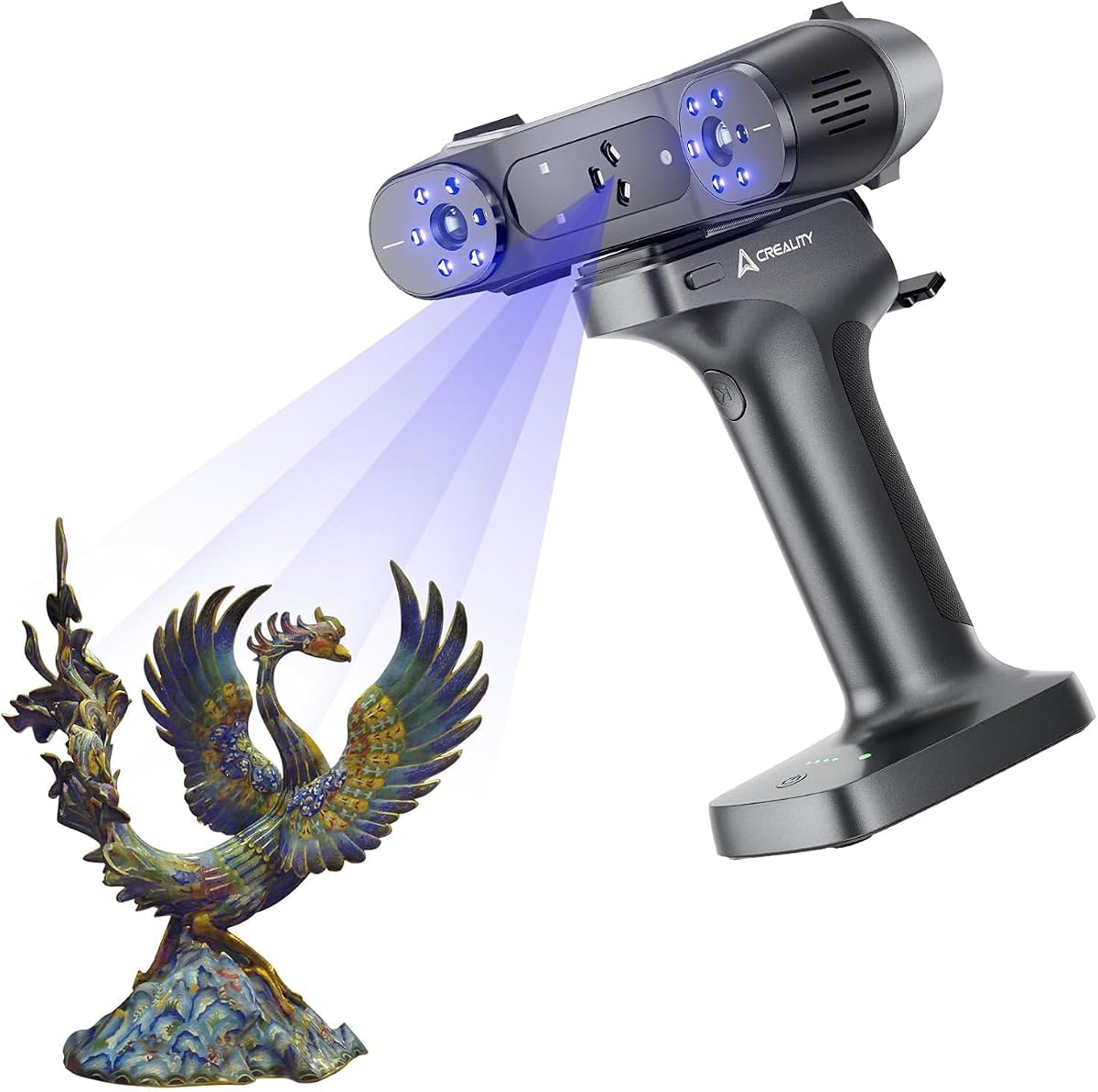
The Creality Otter Lite Basic is an excellent entry point for hobbyists and small businesses needing reverse engineering capabilities. It offers 0.05mm precision which is sufficient for many DIY and prototyping projects without high costs.
We may earn a commission when you buy through this link, at no additional cost to you.
Its dual-mode scanning allows capturing both small details and larger objects effectively. The included kit with turntable and calibration board ensures you can start immediately without buying extra accessories.
While not as fast or precise as professional laser models it delivers solid performance for its price range. The plug-and-play design with smart feedback LEDs makes it approachable for those new to 3D scanning technology.
This scanner is ideal for learners or small workshops needing basic reverse engineering tools. Its balance of features and cost makes it a popular choice for affordable precision work.
Achieve professional-grade accuracy with 0.05mm resolution making it a great starting point for reverse engineering without high costs.
Includes turntable calibration board and markers so you can start scanning immediately right out of the box.
We may earn a commission when you buy through this link, at no additional cost to you.
This standard version of the Revopoint MetroX Pro offers the same core industrial capabilities as the advanced model. It provides high precision with single-frame accuracy up to 0.01 mm ensuring reliable data for reverse engineering.
We may earn a commission when you buy through this link, at no additional cost to you.
Its four scanning modes and automatic turntable simplify capturing complex objects. Real-time streaming to mobile devices enhances workflow efficiency by allowing monitoring without holding the laptop.
As with other models advanced software options like Revo Design require separate purchase and Windows support. However the hardware itself delivers robust performance suitable for industrial measurement and modeling.
Professionals seeking proven accuracy at a competitive price will find this model effective. Its ability to handle dark surfaces without spray makes it a reliable tool for diverse manufacturing needs.
Single-frame precision of 0.01 mm ensures detailed capture for precision modeling and industrial measurement tasks.
No spraying needed on dark surfaces saving time and improving scan quality on challenging industrial components.
We may earn a commission when you buy through this link, at no additional cost to you.
The Creality CR-Scan Raptor Pro offers metrology-grade accuracy with a unique laser setup that excels on dark and metallic surfaces. Its wireless design allows flexibility for scanning outdoors without lab constraints.
We may earn a commission when you buy through this link, at no additional cost to you.
The scanner handles objects from tiny 5mm to massive 4000mm sizes effectively. The software includes tools for body scanning and model processing streamlining the workflow for various industrial applications.
Users need a robust computer with high VRAM to fully utilize its speed and processing features. Without the right setup performance may lag but it still maintains high quality output for most projects.
This model is ideal for teams needing both high precision and mobility. The combination of laser accuracy and wireless features makes it a strong contender for complex reverse engineering tasks.
Achieve 0.02mm volume accuracy suitable for professional inspection and reverse engineering with detailed laser scanning.
Scanning works flawlessly outdoors with laser resistance to bright light allowing mobile use without lab environments.
We may earn a commission when you buy through this link, at no additional cost to you.
The Creality Raptor X features 34 cross blue laser lines enabling rapid and accurate capture of medium to large objects. Its wireless handle allows seamless data transmission via Wi-Fi 6 for greater freedom during scanning.
We may earn a commission when you buy through this link, at no additional cost to you.
With single-frame accuracy up to 0.02mm it delivers detailed results suitable for engineering parts and molds. The 35400mWh battery supports long field work with quick charging to minimize downtime.
While the cost is higher for wireless convenience it offers significant mobility improvements. Users should ensure their WiFi network supports the required throughput for optimal lossless compression speeds.
This scanner is perfect for engineers needing portable high-precision scanning. The anti-shake technology and fast charging make it reliable for demanding reverse engineering projects.
34 cross laser lines enable rapid effortless capture of complete and accurate 3D data from medium to large objects.
Features lossless compression over Wi-Fi 6 allowing quick transfer of scans to computer for efficient workflow.
We may earn a commission when you buy through this link, at no additional cost to you.
The Creality Raptor Pro delivers ultra-high precision with metrology-grade accuracy up to 0.02mm. Its upgraded dual blue laser configuration ensures comprehensive coverage for medium to large objects efficiently.
We may earn a commission when you buy through this link, at no additional cost to you.
NIR structured light scanning allows markerless capture of feature-rich workpieces. The ability to scan black metal objects without powder saves time and protects delicate parts during inspection.
Users must adhere to system requirements for optimal performance. While the setup can be complex the software integration ensures smooth post-processing for reverse engineering workflows.
This model is ideal for professionals needing consistent high accuracy. Its speed and adaptability make it a strong choice for automotive and artifact scanning tasks.
Achieve metrology-grade accuracy of 0.02mm ideal for detailed 3D modeling and quality inspection.
No powder spraying required to scan black metal objects saving prep time and keeping inspection environments clean.
We may earn a commission when you buy through this link, at no additional cost to you.
Selecting the right 3D scanner for reverse engineering requires evaluating several critical factors to ensure the device meets your specific project needs and workflow requirements.
Accuracy defines how close the scan matches the real object. For reverse engineering look for single-frame precision of 0.05mm or better depending on your tolerance requirements. Industrial applications often demand tighter tolerances like 0.01mm to ensure parts fit correctly.
Prioritize models with volumetric accuracy metrics if scanning large objects. Higher precision ensures reliable data for CAD reconstruction without manual corrections.
Scan speed determines how quickly you can capture a part. Faster speeds like 90 FPS reduce workflow bottlenecks especially for production environments. Resolution affects detail capture so choose high dot density for complex geometries.
Balance speed with data quality. High-speed modes may reduce resolution so ensure the device can toggle modes for detailed feature capture.
Different scanners handle shiny or dark surfaces differently. Blue laser or NIR structured light technologies often capture black metal without spray. Spray-free scanning saves prep time and protects delicate parts.
Look for multi-mode lasers or IR support to handle mixed materials. Versatility reduces the need for multiple devices.
Portability is crucial for field inspections. Handheld units with battery support allow scanning without power outlets. Wireless connectivity like Wi-Fi 6 adds flexibility for data transfer.
Consider weight and ergonomics for extended use. Lightweight models reduce fatigue during long scanning sessions.
Reverse engineering requires seamless CAD integration. Ensure the scanner supports formats like STL, OBJ, or PLY and integrates with tools like SolidWorks or Geomagic. Check system requirements for software performance.
Advanced editing features like point cloud merging or alignment tools streamline workflow. Open-source software options offer flexibility for custom pipelines.
Outdoor environments present challenges like bright sunlight. Look for scanners with light compensation or laser modes resistant to high lux levels. Rugged design ensures durability in harsh conditions.
If you scan in warehouses or outside verify light tolerance ratings. Dedicated outdoor filters can enhance performance in variable lighting.
While device price matters consider total ownership costs including software licenses or accessories like turntables. Entry-level models may require upgrades for industrial use.
Invest in features you need now rather than speculative ones. Balance upfront costs with long-term productivity gains from higher accuracy and speed.
Reliable support ensures quick resolution of technical issues. Manufacturers offering online training or extensive documentation reduce learning curves.
Check community forums for user feedback. Active user bases often provide tips for optimizing settings and troubleshooting common issues.
Begin by calibrating your scanner using the provided board to ensure accuracy. Proper calibration prevents alignment errors and ensures precise data capture during scanning sessions.
Use the appropriate mode for your object. Choose cross-line lasers for flat surfaces and parallel lines for fine details to maximize data quality. Scan smoothly without sudden movements to maintain consistent tracking.
After scanning clean the camera lens and sensor with a soft cloth. Store the device in a dry case to prevent damage. Regular software updates maintain performance and security.
Many modern scanners use blue laser or NIR technology to scan reflective surfaces without spray. Check the specific model's capabilities as laser modes often eliminate the need for powder on metallic parts.
Some models support outdoor use with light compensation technology. Verify lux ratings for the specific scanner to ensure it performs reliably in bright conditions without data loss.
Most scanners come with basic software but advanced CAD tools like Geomagic Design X or SolidWorks are needed for engineering. Ensure your chosen scanner supports exporting standard formats for these programs.
Quality handheld scanners can achieve accuracy up to 0.01mm for industrial use. Always verify volumetric accuracy specs if you are working on large objects or complex geometries.
Some models include specific modes for body scanning to capture anatomy safely. Ensure the scanner supports fast frame rates and skin-safe light technology for comfortable user experience.
High-resolution scans require significant processing power. Aim for a system with a strong GPU and at least 16GB RAM to handle data processing efficiently during reverse engineering tasks.
Battery life varies by usage but most premium models offer 2.5 to 4 hours on a single charge. Consider carrying spare batteries for all-day field work to avoid interruptions.
Wireless models with Wi-Fi 6 compress data efficiently to maintain speed. However wired connections may offer slightly more stability for massive point cloud transfers.
We highlighted the Revopoint MetroX Pro for its industrial precision and the Creality Otter Lite Basic for budget-friendly versatility. These top picks offer reliable data for diverse reverse engineering projects.
Focus on accuracy and software compatibility when choosing your device. Balancing speed with detail capture ensures smooth workflows for design and manufacturing teams.
Verify current pricing and availability before purchasing. Technology evolves rapidly so check latest specs to match your project requirements for optimal results.